Quaglino’s London Review, London’s Most Iconic Dining and Entertainment Institution
Some places you go for dinner because of the food, or perhaps the chef. Others draw you in for the vibe or to see and be seen. Quaglino's has always been something slightly different from either. It is an institution in the truest sense of the word, shaped as much by its history as by what happens there on any given evening, and it has occupied a particular place in London's social life for nearly a century in a way that very few restaurants anywhere manage.
There is a kind of glamour that London does well and that has nothing to do with being new. It is the glamour of a room that has absorbed a great deal of history and a great many people and somehow still makes whoever walks in feel that the evening ahead is worth the effort of dressing for. Quaglino's has been doing that since 1929. On the evidence of a recent evening spent at its gilded bar, at its tables, and in the company of a band that seemed to know every song worth knowing, it remains in good working order.

What Quaglino's offers, and what is genuinely harder to find than it sounds, is a complete evening. Not dinner with entertainment bolted on. Not ambient music you eventually stop hearing. Something more integrated than either: a night out in the old-fashioned sense, where the food and the room and the performance are all pulling in the same direction and none of them feels like an afterthought.
You arrive at half past seven. You look up and it is half past ten. Three hours have gone into cocktails and conversation and slow-braised ox cheek and a crooner working the room with the quiet authority of someone who has done this many times and still means it. This is the best kind of London evening. Dress well. Go hungry. Stay late.
Inside Quaglino's: a Room Built to Impress
It starts the moment you walk through the door, and it starts working on you immediately. Its reputation as one of the hottest venues in London is fairly accurate, and you feel it from the first step inside. This is what you envision when you imagine what a great nightclub ought to look like. Not a velvet-rope warehouse pumping bass at 140 decibels, but the real thing. The original template.
The exterior on Bury Street in St. James's gives nothing away. No grand announcement from the street, no queue of the conspicuously fashionable outside. You push through the door, descend the staircase, and the atmosphere shifts in a way that is difficult to prepare for and easy to remember.
The first impression is the Hutch Bar, a glamorous, softly lit space with the air of a speakeasy or private club. Plush leather and deep Chesterfield sofas invite you to linger, while a long, gleaming bar anchors the room. Behind it, bartenders move with the focused precision of people who know exactly what they are doing. This is about the setting as much as the drink. The lounge area with its leather banquettes, beautiful artwork, and different sitting areas would be a fine destination in its own right. But it is also, you quickly understand, merely the overture.
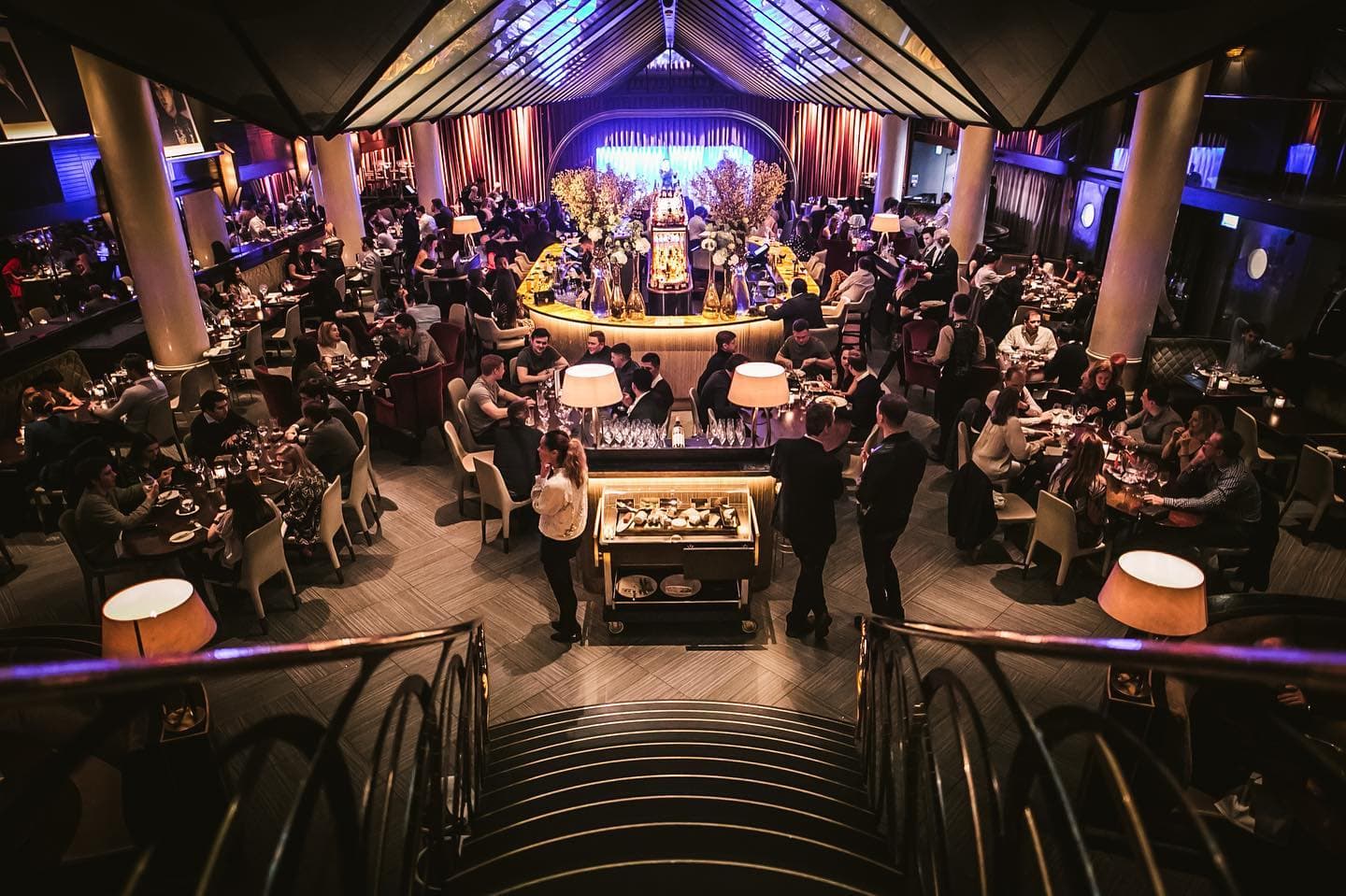
Then you walk to the top of the staircase. And the room below reveals itself entirely. It is the kind of sight that was designed to impress even the most jaded nightlife connoisseur. You also get it immediately what the fuss has always been about. It becomes clear that why, after nearly a hundred years, people are still making reservations and why Qualino’s remains one of the hottest tables in town.
Beyond the bar, the space opens dramatically. You descend and you feel it. The whole architecture of Quaglino's was designed around this single moment, this reveal, this arrival, and nearly a century on it still lands with full force. The staircase is golden and amber, wrought iron and illuminated marble, under-lit so it glows as you come down it. Walking down it you feel, without quite intending to, that you are making an entrance. Because you are. Everyone is. The room is grand. There is simply no other word for it.
Below, what opens in front of you is a vast subterranean dining room with a ballroom sensibility. Two-story ceilings soar overhead, giving the space an airiness and grandeur that defies all logic for a basement. Blood-red velvet curtains frame the walls. Art Deco flourishes appear at every turn. The lighting is golden and flattering, the kind of lighting that makes everyone in the room look better than they did when they arrived.
The effect is somewhere between a grand Parisian brasserie and a Busby Berkeley film set, shot in tones of mink, pewter, and deep gold. You think of Gatsby. You think of the 1930s. You think this is exactly what glamour looked like before the word was worn smooth by overuse, and you feel very glad to be inside it.

At the centre of the room downstairs sits the oval bar, backlit and glowing warmly, framed by an imposing floral installation that draws the eye immediately. Champagne buckets catch the light alongside it. Tables are arranged throughout the space, creating a restaurant that manages to feel both expansive and intimate at once. The mezzanine level wraps above, offering views down over all of it, which only adds to the sense of theatre, the feeling of watching and being watched that a room this size produces naturally. And at the far end of the room, commanding everything, sits the stage, which signals clearly that the evening will not remain still for long.
The Crowd at Quaglino's: Energy, Elegance, and Dressing for the Room
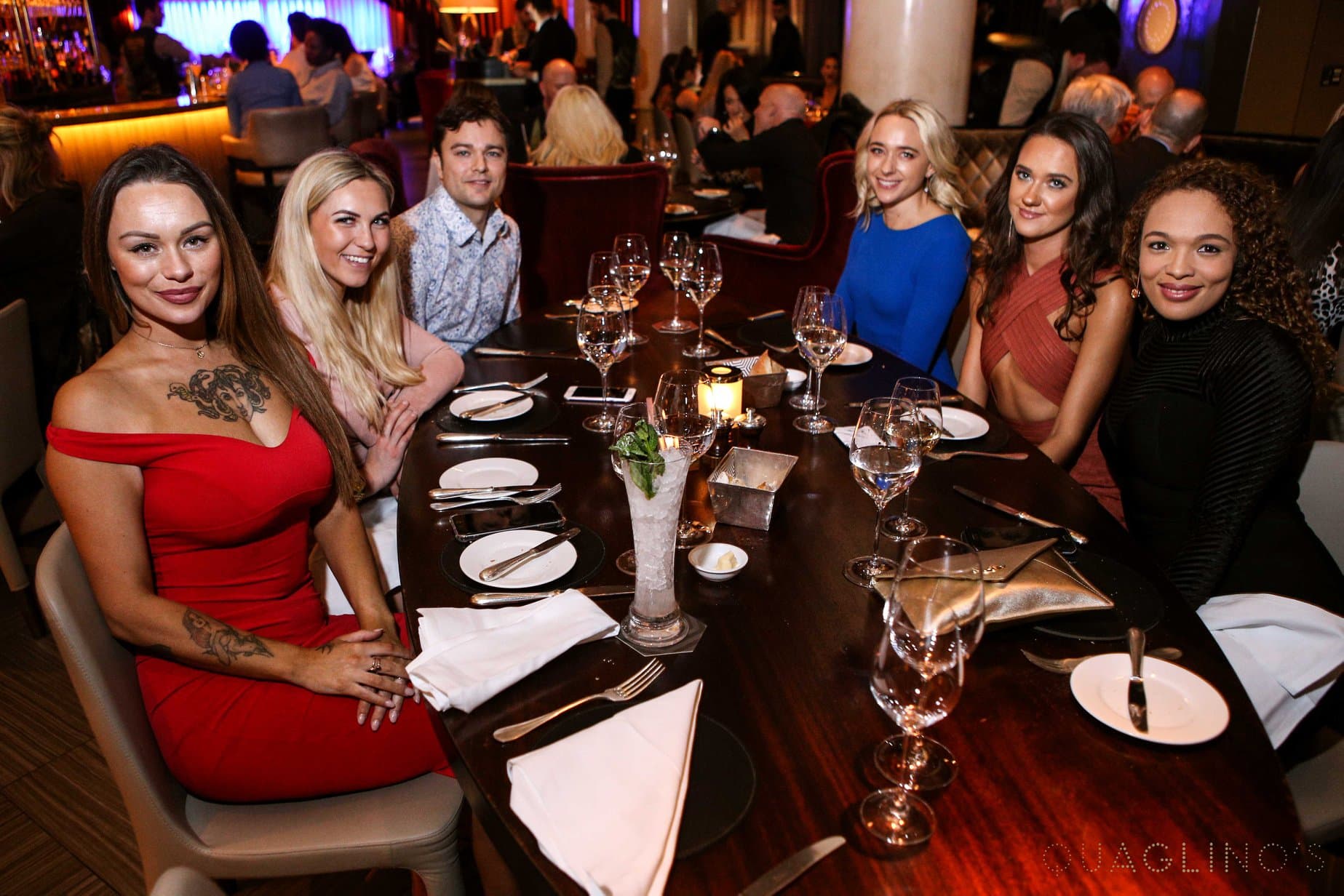
This is a place that asks something of you. People arrive dressed for the night they intend to have. And the room on a good evening is a cross-section of London at its most alive: romantic couples leaning into each other across candlelit tables, the rest of the room pleasantly invisible to them; groups of friends catching up with the easy warmth of people who have been doing this together for years; birthday parties in animated, champagne-flushed full swing in the corners. Couples lean into the romance of it, business hosts set out to impress, and groups gather to celebrate birthdays, milestones, and moments worth remembering.

The crowd is eclectic but the energy is unified, and the unifying force is a collective decision, made somewhere between the coat check and the first drink, to simply have a wonderful time. The room does something to people. It asks them to rise to it, and they invariably do. You find yourself sitting up straighter, laughing more openly, caring rather less about whatever was occupying your mind before you arrived.
Quaglino's History: Royal Scandal, Revenge, and a Century of London Society
To sit in Quaglino's without knowing its history is to enjoy a very good evening. To sit in it with that knowledge is to enjoy something richer and stranger and considerably more layered.

Giovanni Quaglino arrived in London from Piedmont in Northern Italy carrying formidable credentials. He had been maitre d'hotel at the grand Martinez Hotel in Cannes at the age of seventeen. He came to England and worked at The Savoy alongside a colleague named Sovrani, who eventually repaid his loyalty by taking an excessive interest in Quaglino's wife. The response was elegant and decisive: Quaglino opened his own restaurant around the corner, in the basement of the St. James's Palace Hotel on Bury Street, and proceeded to steal every one of Sovrani's customers. Within two years, Sovrani's had closed. Quaglino's was full every night. The Tatler reported a rumour at the time of someone saying "my boss, he pinch my brother's wife, so now I pinch his business." Sovrani sued and won £2,500 in damages. The whole founding of Quaglino's was, in the most satisfying possible way, an act of revenge that produced one of the greatest restaurants in London's history.

What Quaglino understood instinctively was that in those days the maitre d'hotel, not the chef, was the star of a restaurant. As Vogue observed in 1936, to have him greet you respectfully by your surname, to greet him familiarly in return, was a strong tonic for the ego. Contemporaries described him as a man of genuine grace and kindness rather than mere charm. When the Prince of Wales began coming regularly, the restaurant's reputation was assured. By 1935, Quaglino had bought the entire hotel.
The 1930s were extraordinary. The Mountbattens came. Evelyn Waugh came for lunch. King Alfonso of Spain. King Carol of Romania. A table was kept permanently reserved for Princess Margaret. And in 1956, Queen Elizabeth II dined at Quaglino's, making it the first public restaurant ever visited by a reigning British monarch. The room you are sitting in was, on that occasion, quite literally fit for a queen.

The soap opera ran continuously. In 1969, Judy Garland held her fifth wedding reception at Quaglino's. The room had been booked for hundreds. The champagne sat in rows, untouched. The cake went uneaten. More waiters than guests attended. Even Liza Minnelli did not come, sending word that she would make it to the next one. Garland died three months later. That reception, in a room designed for joy, remains one of the saddest footnotes in the history of any London restaurant.
The original Quaglino's closed in 1977. Then in 1993 Terence Conran walked down that staircase and felt, he wrote, a kind of London glamour that had been missing since 1929. Conran, the designer and restaurateur whose influence on how Britain ate and thought about itself is difficult to overstate, bought the restaurant and revived it with the ambition it deserved. His company, now operating as the Evolv Collection, has run it ever since, carrying Quaglino's with evident care into what is now approaching its hundredth year.
His revival was seismic. Cigarette girls circulated the room. The Q-shaped ashtrays he designed became so coveted that 18,000 were stolen in a single year. The Independent declared them among the most theft-prone items in the city. Princess Diana slipped in through the kitchen on occasion to avoid photographers. After the 2014 renovation, Prince Harry was among the first through the doors. The cigarette girls are gone now, replaced by Caviar Girls moving through the dining room on trays. The Q ashtrays have returned for special occasions in chocolate form. The staircase still glows. The room still pulls.
The Hutch Bar: A Tribute to London's Most Scandalous Cabaret Star
There is one more layer to Quaglino's story, and it is the one that perhaps deserves the most attention, because it involves the most remarkable performer ever to inhabit this room and one of the most scandalous and unjustly forgotten careers in the history of British entertainment.

Leslie "Hutch" Hutchinson was a Grenada-born pianist and singer who arrived in London in the late 1920s and proceeded, almost immediately, to become the highest-paid entertainer in Europe. He performed at Quaglino's throughout the 1930s and 1940s, playing most nights to audiences that included the Prince of Wales, Wallis Simpson, and half of Mayfair society. He arrived at nightclubs with a white piano strapped to the roof of his chauffeur-driven car, dressed like an aristocrat, speaking five languages, and charged fees that his wealthiest clients paid without hesitation. He was the hottest ticket in London and he was playing, repeatedly, in this room.
His affair with Edwina Mountbatten, wife of Lord Louis Mountbatten and great-granddaughter-in-law of Queen Victoria, became one of the most explosive open secrets in the city. The scandal effectively ended Hutch's relationship with the establishment that had celebrated him. He was shunned by patrons who had once competed for his attention, turned away from doors he had previously entered by invitation, and largely erased from the cultural record that his talent deserved. He was, in many ways, destroyed by the same society that had made him.
He came back anyway. In 1953 he staged a residency at Quaglino's and the royals came back too: Princess Margaret, Prince Philip, Princess Alexandra, and the Queen Mother all attended his sets in this room. A commemorative plaque now sits in the restaurant marking his decades here. The character of Jack Ross, the jazz singer in Downton Abbey, was based on him. He is one of the great undersung figures of twentieth century British cultural life, and Quaglino's has chosen, admirably, to remember him by name.

The Hutch Bar honors all of that with the seriousness it deserves. It is not merely a bar named after a performer. It is a deliberate act of tribute to a man whose talent was extraordinary, whose life was turbulent and unjustly curtailed by the prejudices of his time, and who called this stage his own for longer than almost anyone else.

The signature cocktail that carries his name, The Hutch at £16, is exactly the right drink for a room with this much history in it. Tanqueray No. 10 Gin meets Akashi-Tai Yuzu Sake Liqueur, the yuzu bringing a bright, citrus-forward Japanese elegance that Hutch himself, a man who defied every category he was placed in, would have appreciated entirely. Rhubarb and vanilla cordial, strawberry and lime oleo saccharum, and sparkling homemade shandy round it out into something clarified, sweet, and complex. Those are precisely the three words the bar uses to describe it, and they are also, not coincidentally, a fairly accurate description of the man it honors. It is a drink worth ordering twice and a story worth knowing before you do.

Live Music at Quaglino's
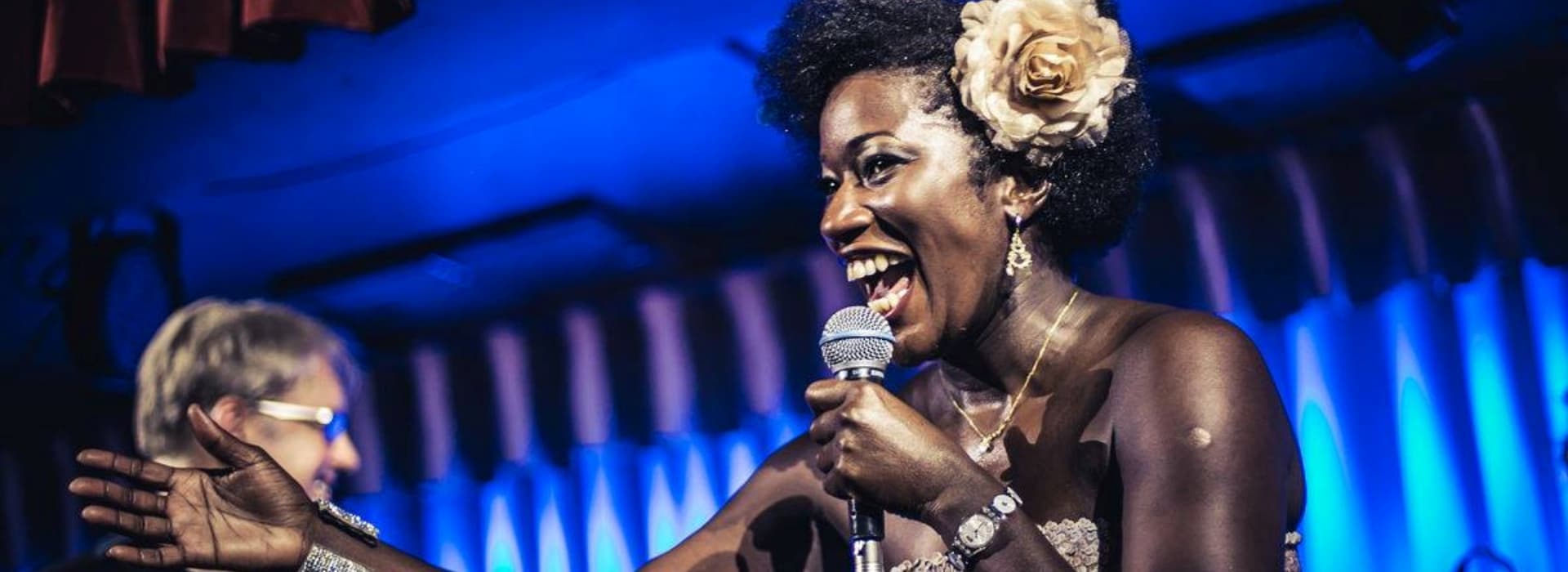
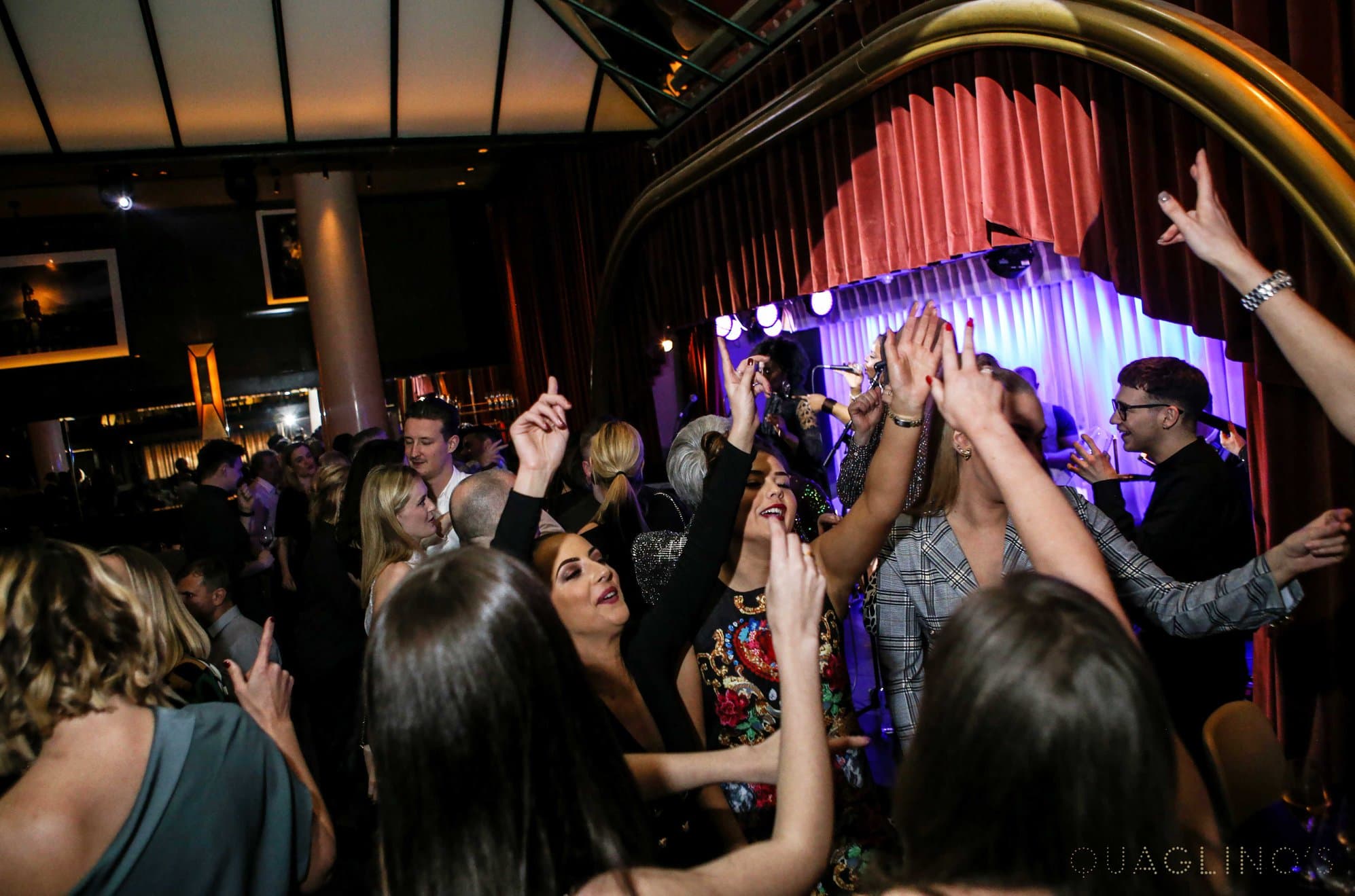
The stage at the far end of the main room is not decoration. It is the organizing principle of the entire evening, the thing everything else is quietly arranged around. Live music threads through the night, giving the room its pulse. The energy shifts as the evening unfolds, moving seamlessly between dinner and performance, and the transition is so smooth you barely notice it happening until you are already inside it.

On the evening in question the act was Jamie and the Jukebox Junkies, and that name turns out to be an entirely accurate description of the playlist. The performance leaned into a jukebox spirit, a setlist built from familiar favourites, the kind of songs you would choose yourself given the chance. Jamie, the lead singer, is a proper crooner in the tradition the room was built for, and he had behind him a four-piece band: French horn, drums, bass, and guitar.
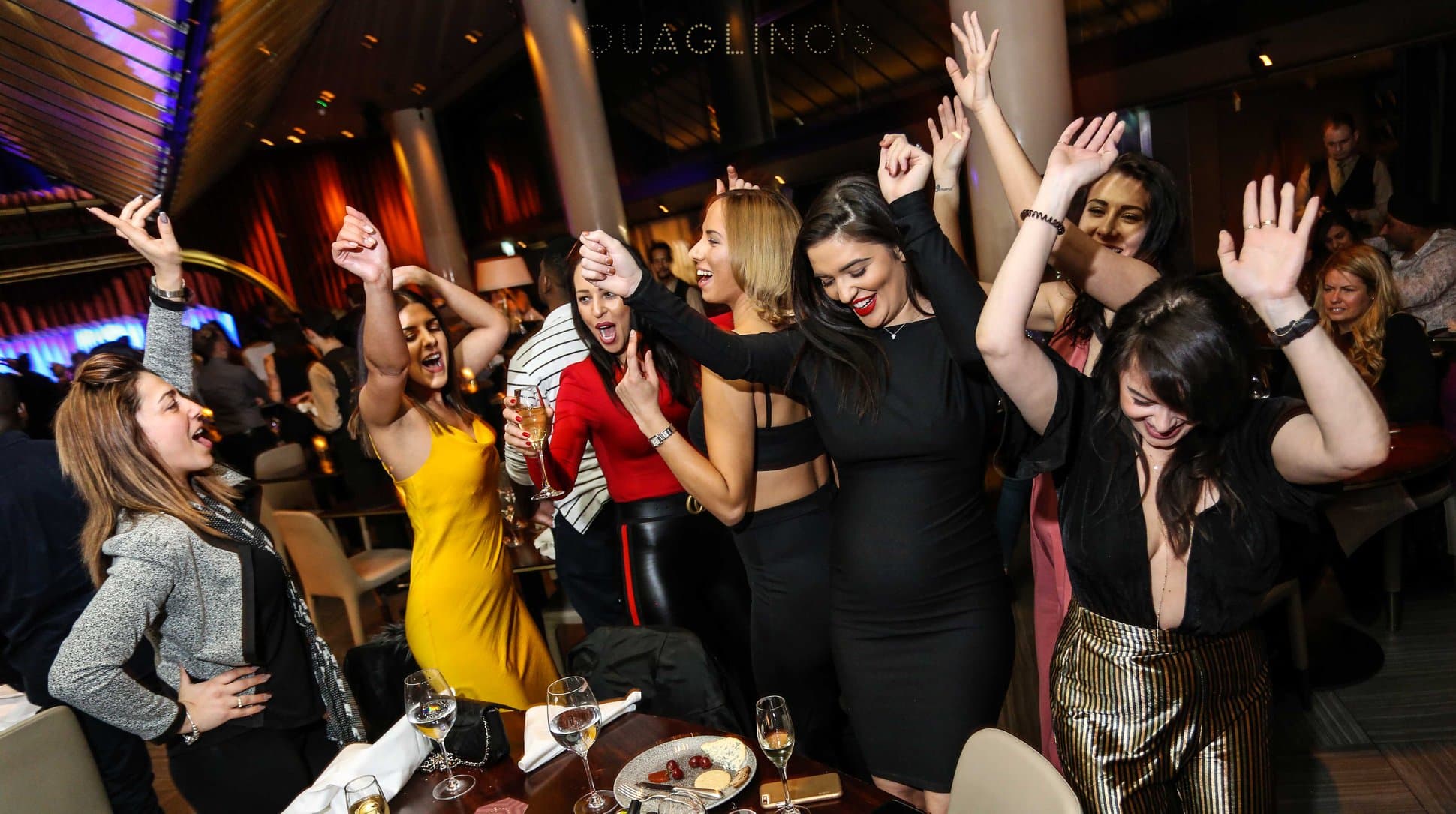
The singing was very good. But it was the song list that made the night. Motown. More current material. A sweep from Marvin Gaye's Grapevine to Daft Punk's Get Lucky, leaning into soul and R&B and pop, landing on songs that everyone in the room knew and had been waiting to hear without quite knowing they were waiting. It creates an easy, generous connection between the stage and the room, a shared soundtrack that carries the evening forward and makes strangers feel briefly like they are all at the same party, which in a sense they are.
Some tables watched and tapped their feet. Others sang quietly along. One or two danced in their seats with the uninhibited pleasure of people who have decided they are going to enjoy themselves regardless, and were absolutely right to make that decision. At some point during the second set you stop being certain whether you are at a dinner with entertainment or a performance with dinner. The answer, happily, is both simultaneously, and neither is diminished by the other. That equilibrium is genuinely rare and genuinely difficult to achieve, and Quaglino's has been achieving it since the 1930s when Hutch himself performed from this same stage.
Dining at Quaglino's
And then, of course, the food arrives, grounding the experience just as the music lifts it. No gimmicks in the kitchen, which turns out to be exactly the right instinct for a room like this.

The winter vegetable and chickpea salad with butterfly sorrel, sour apple, and maple mustard dressing was fresh and precisely balanced, the kind of starter that earns its place rather than simply filling it. The chicken liver parfait with pain d'epice, port-poached pear, and walnut croustillant was the more impressive of the two, beautifully plated and rich without heaviness, the pear doing exactly the right amount of work against the depth of the liver. Really nice presentation, and the kind of dish that reminds you the kitchen is paying attention.

For mains, the honey and red wine glazed ox cheek with wild boar tortelloni, burnt onion puree, and black autumn truffle was a long-braised, deeply savory thing that justified every minute of its cooking time. The stone bass with chargrilled octopus, squid ink aioli, and red pepper piperade was technically assured and confidently delivered. Sides of wildflower honey glazed heritage carrots and French beans with caramelized shallot butter were both better than sides usually manage to be, which matters more than it sounds when the whole table is sharing.
Desserts closed the meal with authority. The gingerbread and blackberry marquise with blackberry curd and muscovado vanilla ice cream was seasonal and well-judged. The chocolate pot de creme, 54 percent dark chocolate cremeux with macadamia and hazelnut mousse, cocoa meringues, and toasted macadamias, was the kind of dessert that ends an evening rather than trailing it off. A bottle of wine ran through all of it. The list runs to over 300 bins and tips sensibly toward the old world. Everything held together.
Why Quaglino's Remains One of London's Great Nights Out

A great way to spend a night in London. That is perhaps the simplest and most honest thing to say about Quaglino's, and it contains rather more than it appears to. To be fed well. To drink something genuinely special in a bar named after a man who scandalized the aristocracy and enchanted royalty from this very room. To have live music that actually engages you, that makes you lean forward rather than tune out, that produces, somewhere around the second set and the third glass of wine, the specific pleasure of hearing a song you love performed by people who also clearly love it. To sit inside a room with nearly a century of extraordinary stories pressed into its walls and feel, at some point during the evening, that you are genuinely glad to be exactly where you are and nowhere else.

That is what Quaglino's does. It has been doing it, with only the briefest of interruptions, since 1929. The room has hosted royalty and scandal and heartbreak and celebration and some of the most remarkable performers of the twentieth century. It has been declared finished more than once. It has declined to cooperate with that assessment.
Go. Dress for it. Order the Hutch. The room deserves that much, and it will return the favor many times over.

Glenn Harris
Glenn Harris is an accomplished journalist focusing on luxury travel, fine dining, and exclusive lifestyle events. His wanderlust has taken him to over 128 countries where he constantly strays off the beaten path to uncover exotic locations, travel gems and exciting experiences to capture.
Read More
Salon Privé 2026 at Blenheim Palace: Inside Britain’s Luxury Automotive Garden Party
La Belle Epoque: European Waterways’ Luxury Burgundy Barge Cruise

Great Rail Journeys and Amadeus Rhine River Cruise: Exploring the Rhine by Rail and River