CroisiAfrica: An African Safari by River, Lake and Land
From Johannesburg’s divided streets to the elephant-lined shores of the Zambezi, from a spectral forest on Lake Kariba to the thundering spectacle of Victoria Falls, CroisiAfrica’s nine-day journey reveals a continent of extraordinary contrasts. It is a journey by planes, boats and safari vehicles through South Africa, Botswana, Namibia and Zimbabwe.
CroisiAfrica’s epic itinerary
The itinerary begins in Johannesburg, where the legacy of apartheid remains painfully visible. It concludes at Victoria Falls, one of the natural wonders of the world. Between the two lie the wildlife-rich Chobe and Zambezi rivers, remote island villages, and the vast Lake Kariba.
Our African adventure opens at 54 on Bath, a five-star boutique hotel in Rosebank. With stylish echoes of an Edwardian gentleman’s London townhouse, it sits in what is probably Johannesburg’s most affluent business district. Over a three-course lunch and a choice of red, rosé or white wine, our small international group gets acquainted. English is the linga franca with French a close second.
Johannesburg and the legacy of apartheid
Our guide, Papy, takes us on a tour of Johannesburg, a city shaped by gold, migration, industry and the brutal legacy of racial segregation.
Strangely we begin the story of apartheid with something of an ending. In the velvet-lawned gated suburb of Houghton, we pause outside Nelson Mandela’s final palatial home. The grand mansion, surrounded by immaculate lawns, seems a world away from his impoverished birthplace which we visit later.

At the Apartheid Museum we are randomly assigned tickets for white and non-white people, an unsettling act of segregation. The building’s oppressive architecture, brutalist concrete, prison-like bars and restricted sight lines, is unsettling, even before we encounter the exhibits. Hanging nooses record 131 people executed for opposing the apartheid regime. The museum disturbs, particularly a recreation of a cell where Winnie Mandela spent 491 days in solitary confinement.
In Soweto, the Southwestern Township, we pass cramped concrete homes and sprawling settlements of corrugated-metal shacks. Some sharing one toilet between 40 people. The legacy of apartheid remains; a stark contrast to the lilac and purple jacaranda blossom of Johannesburg’s wealthy suburbs. Though Papy gives us a spark of entrepreneurial hope when we briefly pause to view the Soweto bakery that he started five years ago.
On Vilakazi Street, we are reminded that this was home to two Nobel Peace Prize laureates, Nelson Mandela and Archbishop Desmond Tutu. The street also evokes memories of the first day of the 1976 Soweto uprising, when 23 students were killed protesting against apartheid’s education policies.
The following morning, Papy takes us to Johannesburg’s OR Tambo International Airport for our scheduled flight to Kasane, Botswana. Papy produces boarding cards and for five minutes we are reunited with our luggage for check-in.
The Zambezi and CroisiAfrica’s Cascades Lodge
At Kasane we are close to the confluence of the Chobe and Zambezi rivers, crossing the Chobe River by boat and presenting our passports and visas at a Namibian border post, before sailing towards Cascades Safari Lodge on the Zambezi. Here, Namibia’s narrow Caprivi Strip points, like a finger, towards Zimbabwe.
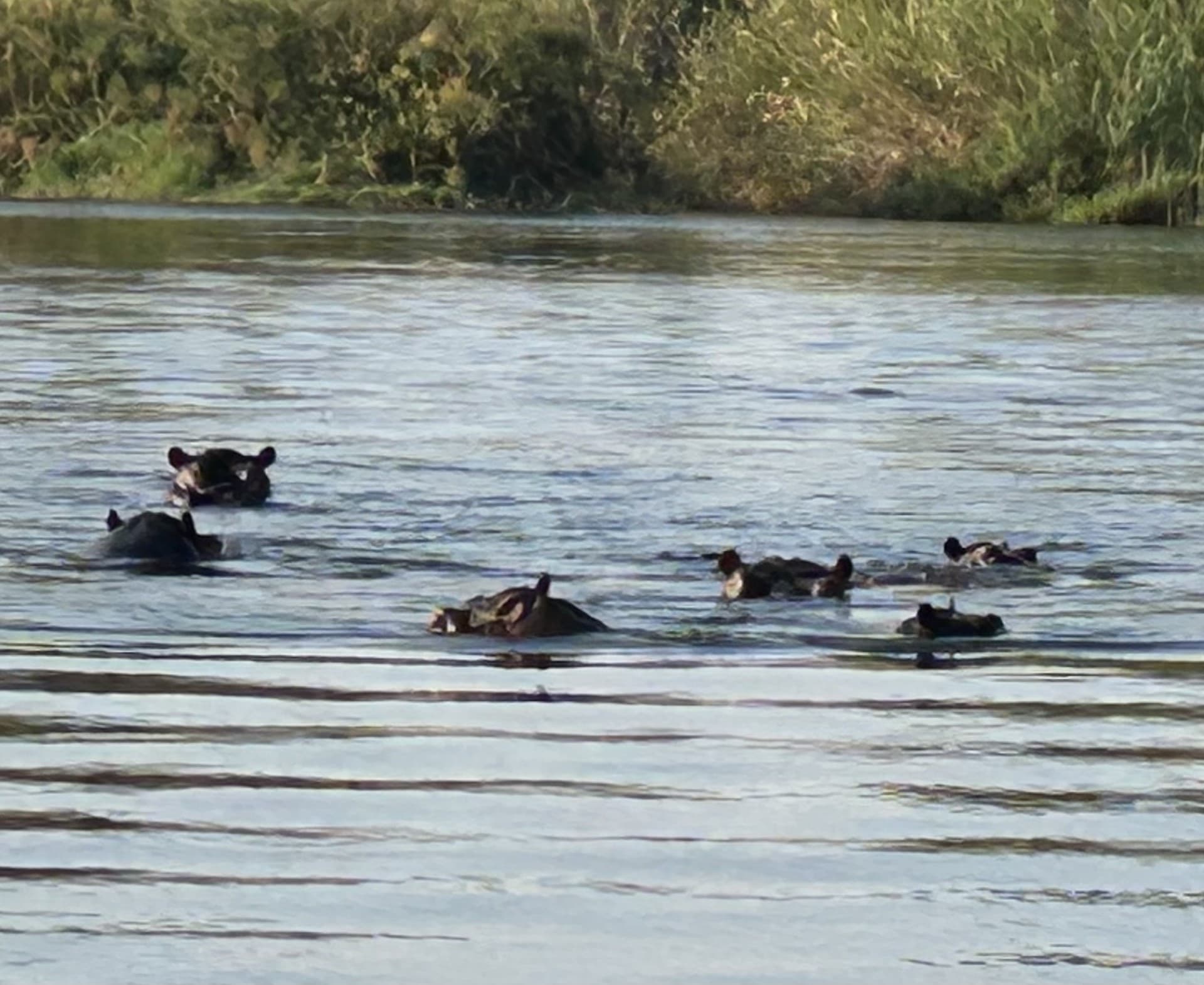
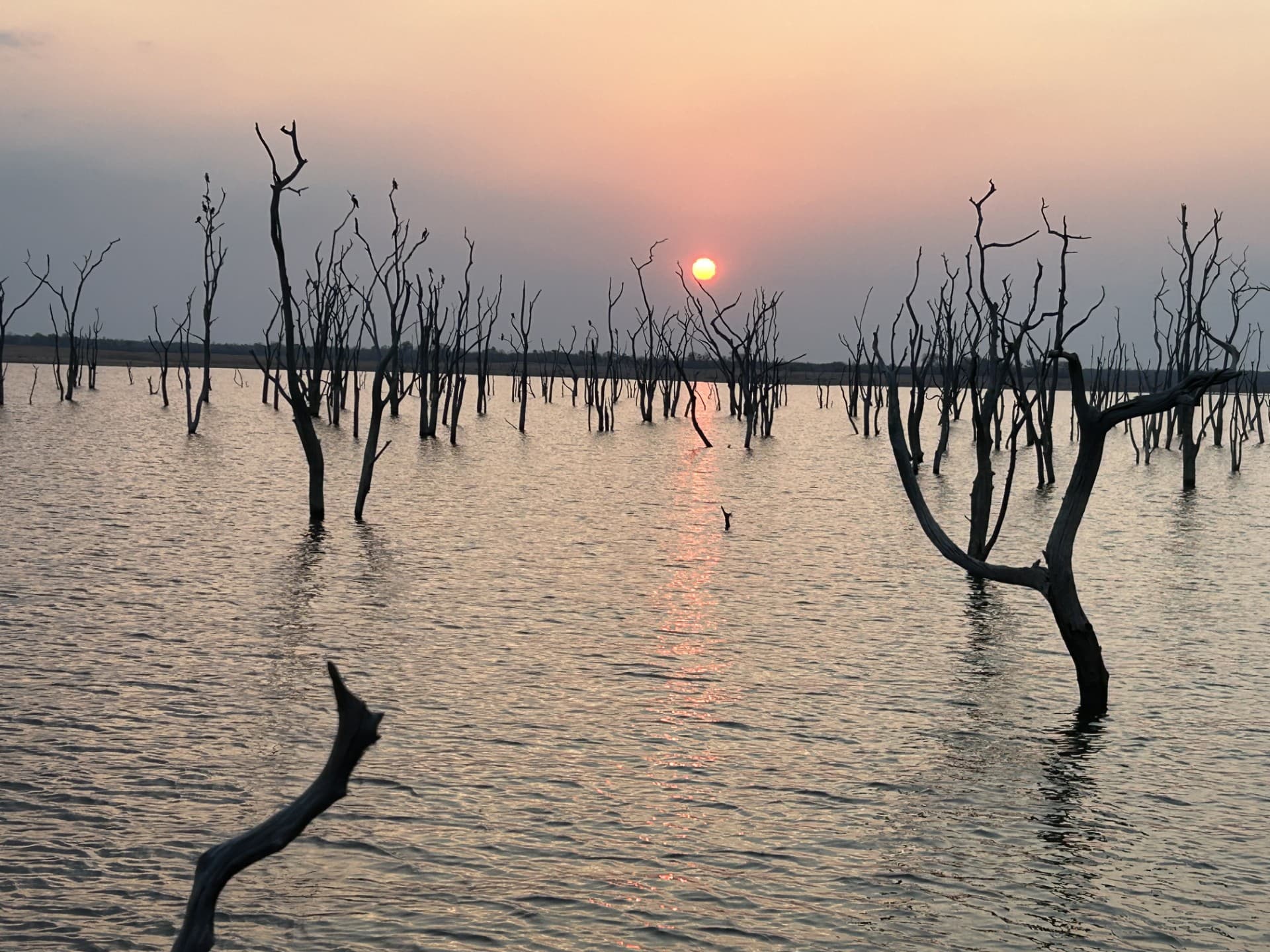
Our guide, Lennon, expertly manoeuvres the boat to give us the best views of crocodiles basking on white-sand banks and submerged hippos, only their ears and nostrils showing, cooling themselves in the Zambezi. Fishermen pass in narrow dugout canoes carved from jackal-berry trees.

The tranquillity is deceptive. Lennon tells us that earlier in the month two fishermen were taken by crocodiles. On an island without road access, where daily life depends on boats and the river, the danger is never far away. As he says, “The river is life. The river is death.”
After three country’s border formalities, Cascades Safari Lodge provides a peaceful sanctuary. Reserved exclusively for CroisiAfrica guests, the intimate property has just eight detached, air-conditioned bungalows connected by wooden walkways. Huge windows frame the Zambezi, while a small private swimming pool, outdoor showers and carefully positioned seating encourage guests to focus on the river-views.
Next morning, picking up more passport stamps, we head back to Botswana for our Chobe day. Lennon our guide, shakes his head, “Even if you are attacked by a croc, you have to get two passport stamps before you head for the hospital in Botswana. Some guys don’t make it.”
Safari along the Chobe River
We are visiting in late September, “deep in the dry, dry season” says Lennon, almost poetically. Botswana’s thirsty wildlife is drawn to the Chobe River making this one of southern Africa’s great safari destinations.
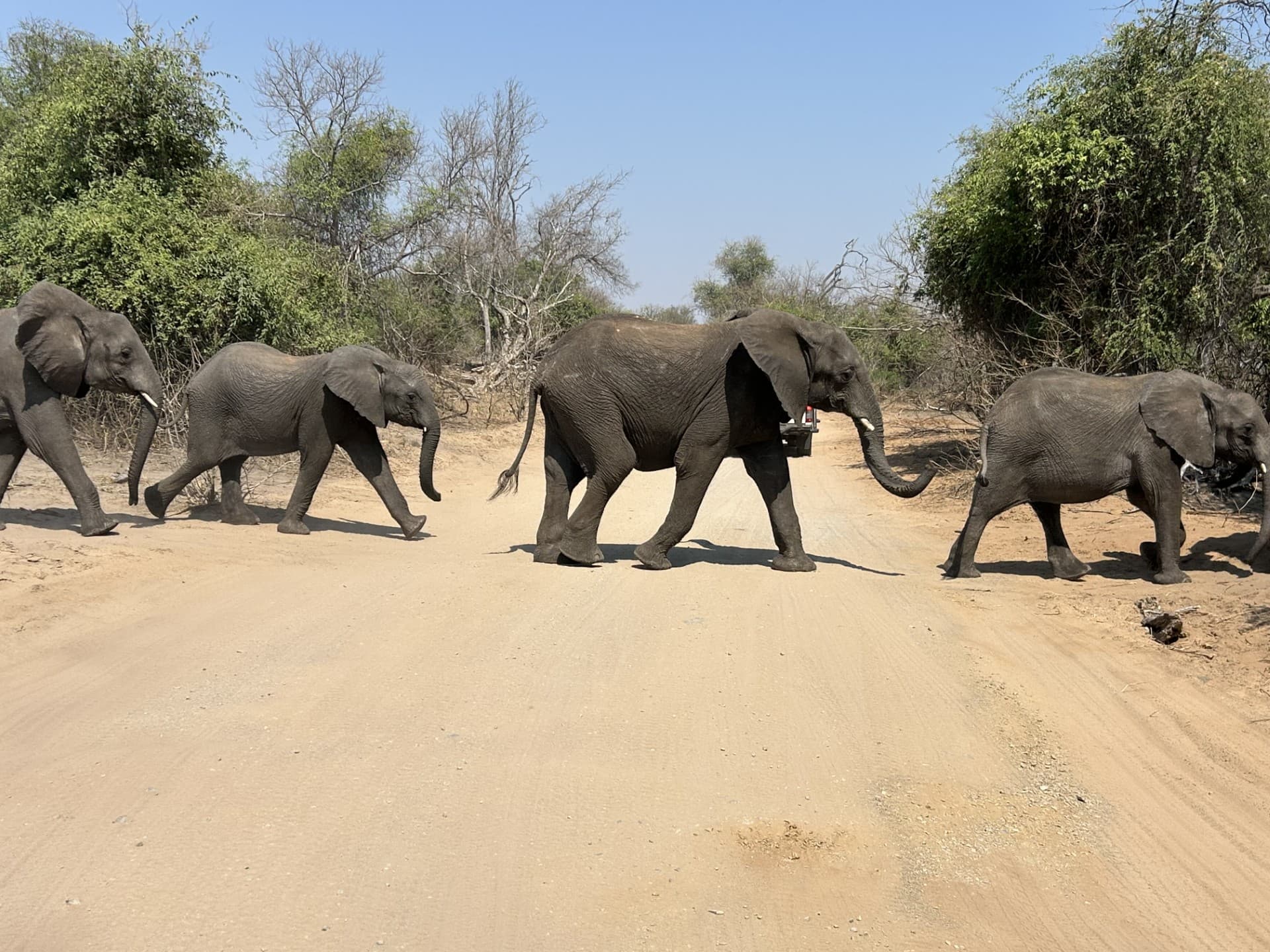
Elephants appear in remarkable numbers, drinking and bathing. As a parade of elephant crosses our track, Lennon points out an elephant with a missing right tusk, “He probably led with his right tusk and lost it in a fight.”

Then Lennon spots a pride of 14 lions, stalking a herd of buffalo. The lions are lean, their ribs visible beneath their coats. Listless cubs, in particular, appear desperately in need of a successful hunt. We watch from a safe distance, captivated by the tension of the encounter. The buffalo remain alert; the lions move cautiously. Lennon tells us that the pursuit of the buffalo could continue for hours, even days. The African bush never guarantees fast food, not even for alpha predators.
For us sourcing lunch is easier, we board a river boat; plates of salad, barbecued meat and chilled drinks appear as we drift towards elephants shaking mud from waterlilies. Elephants appreciate tender waterlilies that are easy on their teeth. When they wear out their seventh set of teeth they die from starvation.

A village visit and life along the Zambezi
The following morning brings a different kind of safari. After breakfast, we walk with Lennon towards his village. Using a stick, he draws a map in the sand to remind us of where we are. But in this part of Africa, national borders can seem arbitrary as the rains raise river water levels by five metres.
Lennon explains that villages are largely organised around extended families. In his own village, his grandmother is the elder. We meet his mother, who shows us the scars left by a crocodile attack while she was washing clothes in the Zambezi. “She didn’t sleep for two months,” he adds as a chilling postscript.

Under the shade of an enormous baobab tree, we watch a traditional dance performed by members of neighbouring villages. A tree is so old that its origins predate the village’s collective memory. The dancers’ blue swirling skirts, rhythmic movements and smiles show us that the women are determined to preserve their heritage.
We walk on to the island’s school, which serves hundreds of pupils, some of whom walk several kilometres to attend. Not every child makes it into the classroom: the cost of a school uniform can be prohibitive for some families. Lennon points to a well-built health centre, “But it has no doctor,” Lennon concludes. As we leave the village, Lennon drops one more chilling statement, “You don’t see many men. Male life expectancy is low.” In part, that explains why some men have two or three wives.
Back at Cascades, lunch includes barbecued impala loin, less gamey than venison, more tender than beef. By coincidence the strips on the impala’s rear look like the McDonald’s trade mark. As we munch, we prove Lennon’s words, “Everyone eats impala, it’s the McDonalds of the bush.” After a couple of hours of relaxation, we set off on the Zambezi for sunset drinks. Lennon slows to show us a water lily. Local children use its lengthy and hollow stalk as straws for drinking. “These lilies give the water the colour of iced tea,” Lennon, again poetically, adds.
He guides the tender towards a sandy beach and opens a bottle of champagne. We discover that we are technically in Zambia, although the seasonal flooding means that border controls are not always practical here.
As we sail back through the dusk, we pass the lanterns of a temporary fishing settlement. Its inhabitants build homes from reeds and papyrus, housing them during the dry months before rising water forces them to retreat.
Lake Kariba and CroisiAfrica’s African Queen
Time to leave Namibia and we fly north from Kasane in a small Cessna. There are no boarding passes, no familiar cabin announcements and no trolley service. We walk to the aircraft when it is ready, receive a bottle of water and listen to the pilot’s safety briefing on the runway.
The first short flight takes us to Victoria Falls airport for Zimbabwean immigration formalities. We then hop over Lake Kariba towards a red-clay landing strip in Matusadona National Park; the pilot circles the strip to check that it is clear of wildlife.
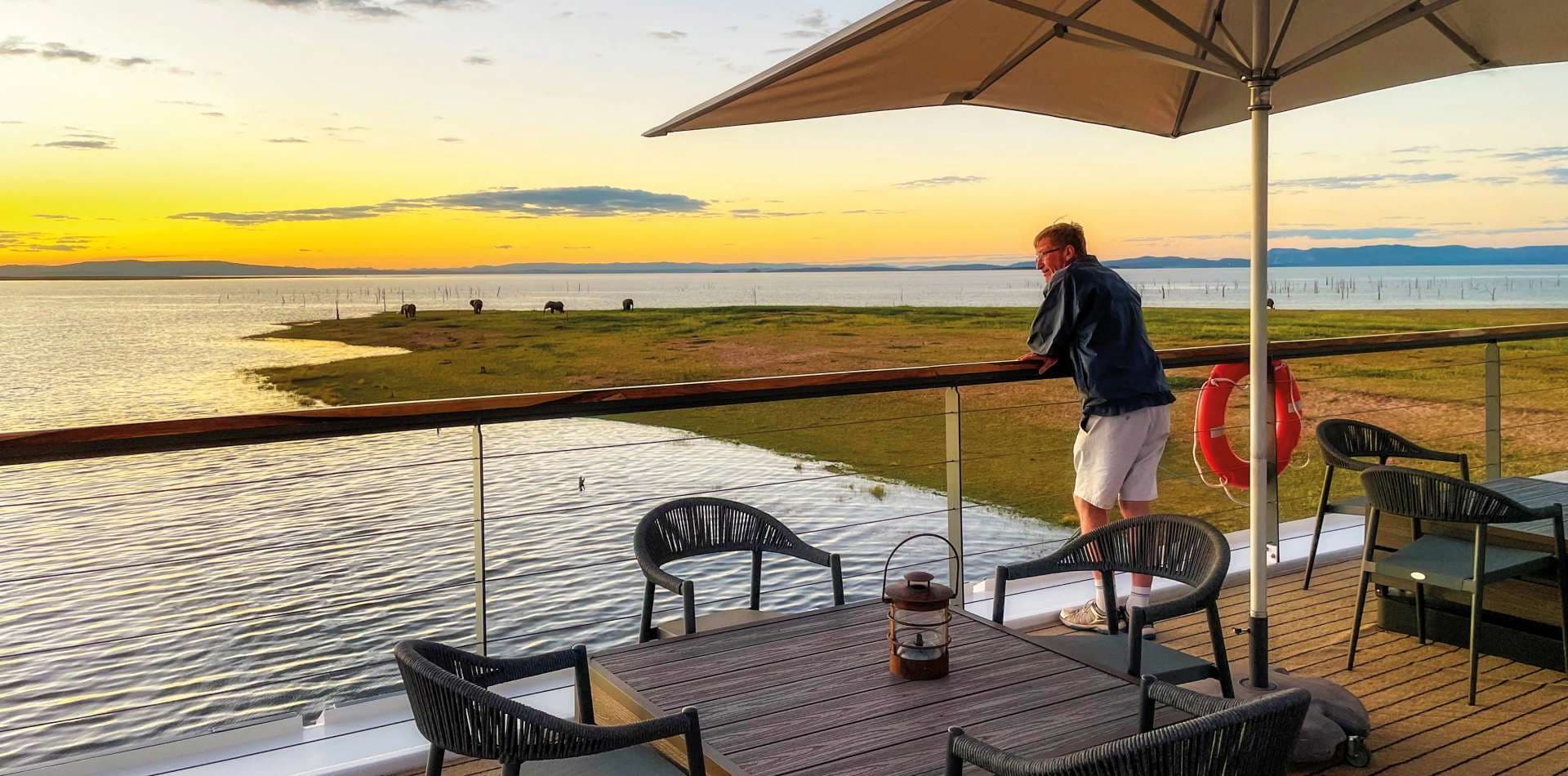
Two safari vehicles await us, and a large rug serves as an improvised baggage carousel. From here, the transfer to the African Dream, our floating home for the next few nights, becomes a game drive in its own right. Elephants graze against the late-afternoon light as we approach the lake.

Lake Kariba is a place of extraordinary scale and haunting beauty. Created by the construction of the Kariba Dam, completed in 1959, it provides hydroelectric power for Zimbabwe and Zambia. Its creation, however, came at a considerable human and environmental cost.
The lake submerged a vast area of the Zambezi Valley, forcing around 50,000 people to relocate. Animals were also left stranded as the rising water isolated shrinking islands. Operation Noah, the subsequent wildlife rescue effort, saved more than 6,000 animals. Rupert Forthergill, back then Rhodesia’s Chief Game Ranger, organised the operation, and an island is named in his honour.
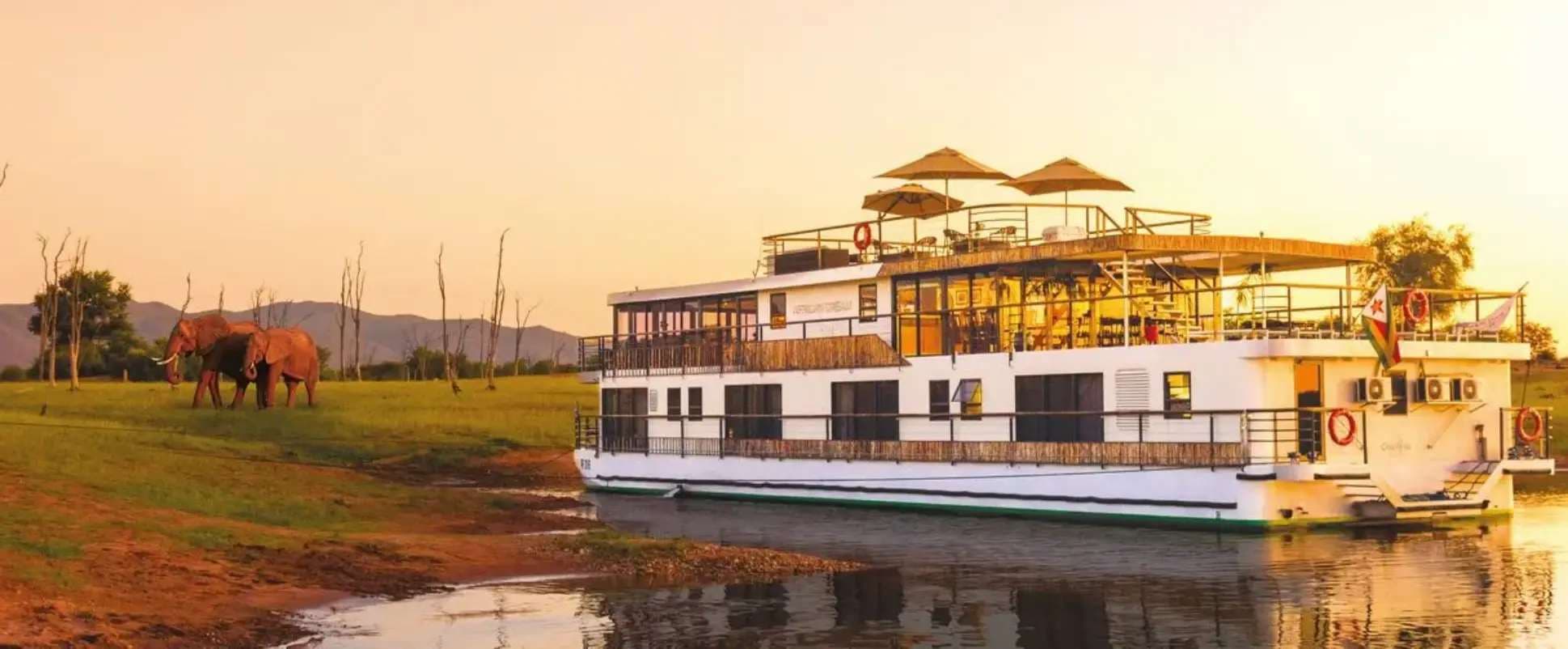
Our home on the lake is the African Dream, an intimate vessel accommodating just 16 guests. The transition from safari vehicle to boat is seamless. Our bags are delivered to our cabins, a welcome drink appears, and the crew outlines the menu and the next day’s plans.
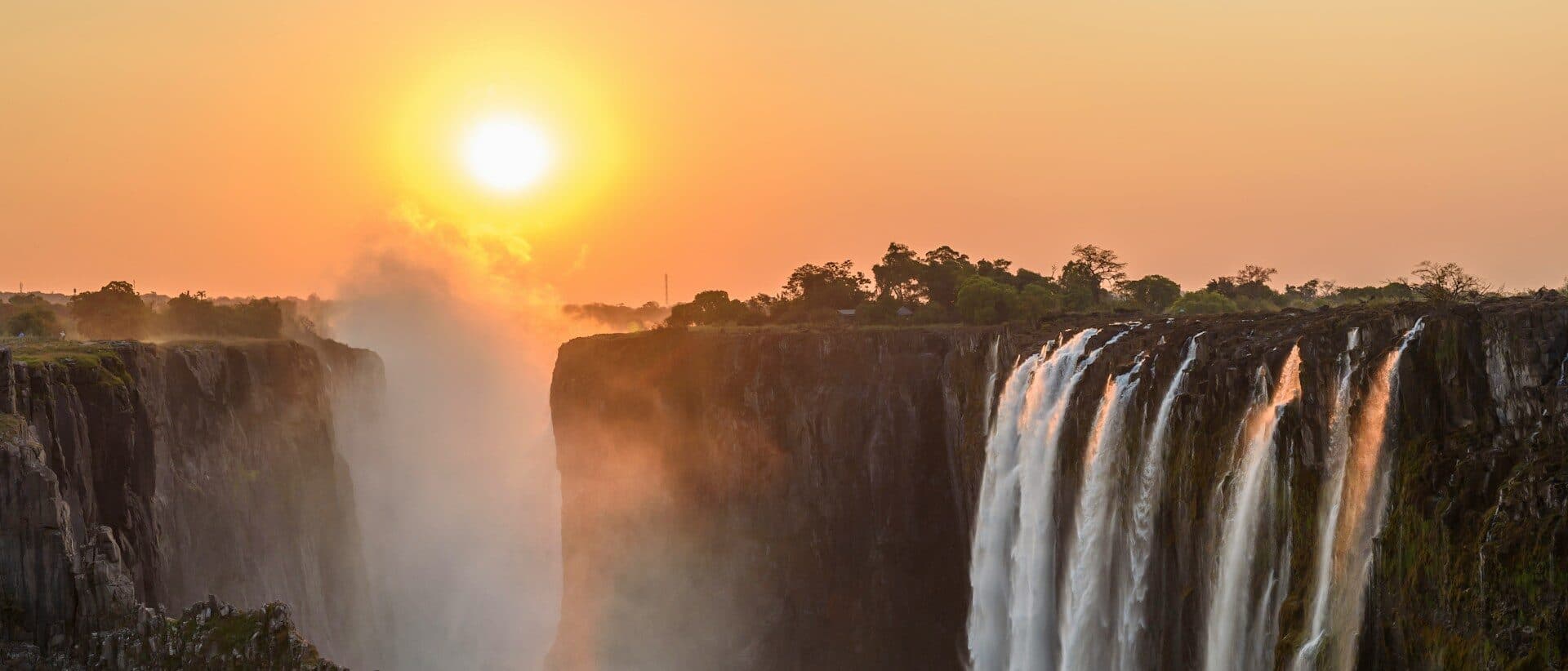
The following day, we transfer to a smaller boat to explore the lake’s drowned forest. The remains of mopane trees rise from the water, their pale, spectral trunks resembling sculptures. Some have stood submerged for decades, yet their branches still provide nesting places for fish eagles, the striking birds depicted on Zimbabwe’s flag.
Beautiful but disturbing, a landscape once occupied by living woodland has become a ghostly aquatic wilderness. Occasionally, elephants, trunks raised like periscopes, swim between the islands.
Lake Kariba is also home to an estimated 10,000 crocodiles. Our first sighting does not inspire much respect, “Barely long enough for a belt,” says Vanessa our guide. Others may grow to around six metres over lives that may last 120 years.
After lunch aboard the African Dream, as ever with three courses and wine, there is time for a restorative snooze on the sun deck. As evening approaches, we take the tender out again for sundowners plus catch-and-release fishing.
Matusadona National Park safari
The next morning begins early. We head into Matusadona National Park with driver Richard stopping to show us moth larvae on the bleached horns of an antelope skull. Nearby, white hyena droppings reveal the high bone content of the animal’s diet. The calcium in the remains benefits tortoises as they develop their shells and eggs. “Nothing,” Richard emphasises, “is wasted in the bush.”
Richard studies vultures’ movements and spies fresh lion tracks. We follow the trail, searching for signs of the animals and looking towards the directions in which the lions might be travelling. For three hours, we drive, pause, drive and search.

Eventually, we find a lion feeding on a waterbuck carcass. The lionesses and their two cubs remain nearby, waiting for the dominant male to finish eating before approaching for their share.
As we drive away from the lions, a towering bull elephant confronts us on the rocky track, stares and then diverts to the right. “That’s a stubborn elephant. I think he’s the one who killed a waiter at the lodge last week,” Richard whispers.
Back aboard the African Dream, the crew and guests gather for a farewell evening. With the weather turning, a preview of the rainy season, Vanessa hosts cocktails on board rather than taking us out for a final sundowner.
Our final transition begins with a visit to Kariba Dam, where a presentation explains the engineering achievement that created the lake and transformed the surrounding landscape. Then it is back into another small Cessna aircraft for the flight south to Victoria Falls.
Victoria Falls and the grand finale
After days of remote riverbanks, wildlife and quiet settlements, the arrival in Victoria Falls feels almost metropolitan. We board a boat for lunch on the Zambezi, passing handsome properties and manicured waterfronts that could sit on the Thames. The illusion is quickly interrupted by the wildlife. Crocodiles lurk along the banks. Meanwhile the menu reminds us of where we are, with crocodile skewers, ostrich salad and Amarula cheesecake among the options.
CroisiAfrica’s grand finale
At Victoria Falls Safari Lodge, there is time to relax by the swimming pool. Most of the group are happy to take advantage of the afternoon’s leisure, but I decide to join one last game drive.
My destination is a private game reserve covering some 6,000 hectares, home to a conservation project that has grown from just six rhinos in 2006 to a population of 17. The animals are notoriously elusive, particularly the younger ones.

Driver Nixon has a decade of experience and an instinct for finding wildlife. He believes the oldest female, now around 40, may be heading towards a waterhole. He stops and switches off the engine. The bush is quiet except for distant bird calls and the occasional rustle of leaves. Eventually, Nixon hears a rhino browsing and crunching twigs. After careful manoeuvring, we catch brief glimpses of the rhino through the vegetation. There is just enough time for a few photographs before she disappears again. We celebrate with a sundowner.
The final morning brings another early start, this time with breakfast overlooking the lodge’s waterhole. Elephants come to drink below us, providing one last reminder of how completely wildlife has shaped the journey.
Then we travel to Victoria Falls itself. Moses, our guide for Zimbabwe, equips us with ponchos before leading us through the rainforest created by the falls’ constant spray. The vegetation is lush, the air humid, and the sound of the water grows louder as we approach the viewpoints.
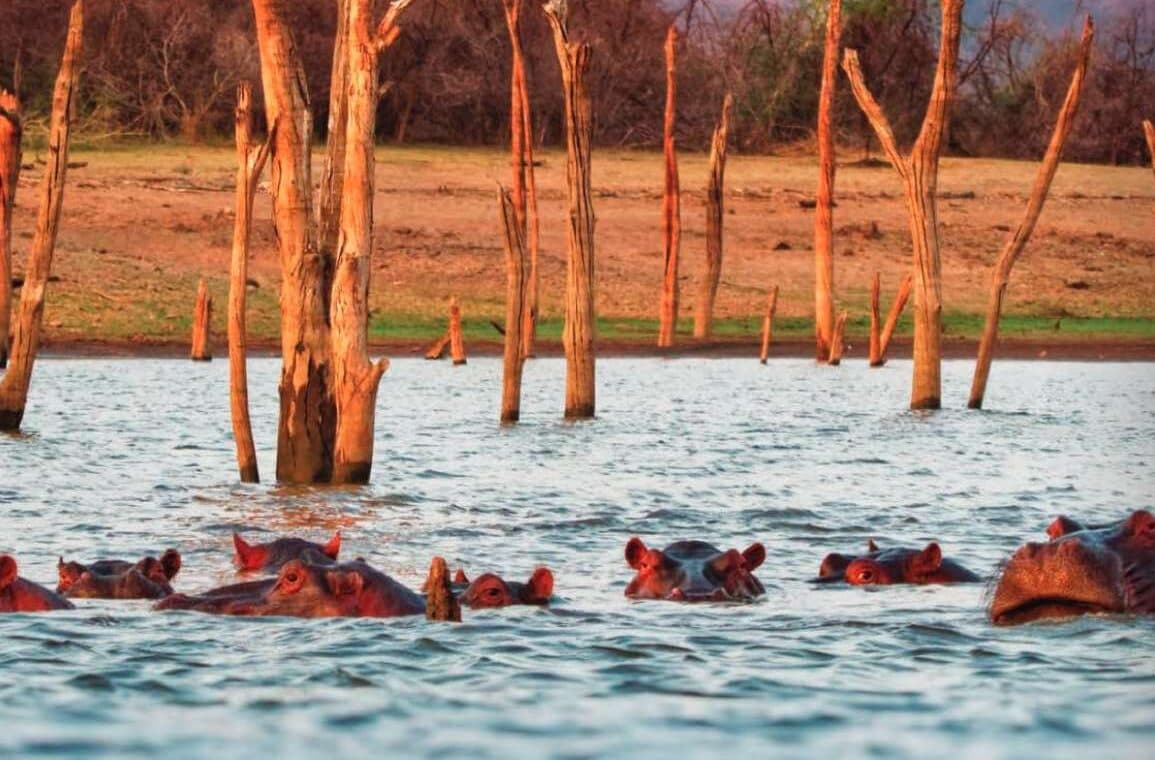
Victoria Falls is immense, its scale difficult to appreciate until you stand before it. Water plunges into the gorge in a thundering curtain, sending clouds of spray into the air. The surrounding forest seems to shimmer in the mist.

By mid-morning, we are back at the lodge, checking out and transferring to Victoria Falls airport. Most guests will fly south to Johannesburg before continuing their journeys home.
As we travelled, time after time, one French traveller had involuntarily exclaimed, “Incroyable!” The trip had been a succession of incredible experiences; elephants feeding on water lilies, lions stalking buffalo, crocodiles lurking beneath the surface, fish eagles diving for tiger fish and champagne sundowners on a sandy Zambezi bank. Truly “Incroyable.”
Michael Edwards
Michael Edwards had his first travel article published by The Independent in 1986, on Santa Catalina just off the Californian coast. Subsequently, he has written for The Guardian, Telegraph and many other media. He enjoys writing on restaurants, travel and golf. “In 1980 I read Lauren Van der Post’s Lost World of the Kalahari and never dreamed that one day I would be tracking through the desert with a Bushman before writing my own piece on The Land Made by The Devil,” says Michael.
Read More
Barcelona Beyond the Bar: Discover the City's Hotel Bars, Rooftops and Beach Clubs
Salon Privé 2026 at Blenheim Palace: Inside Britain’s Luxury Automotive Garden Party
La Belle Epoque: European Waterways’ Luxury Burgundy Barge Cruise