Château de la Resle Burgundy Review | Art, Wine, and Design Estate Stay in Auxerre France
In England, the fantasy of a vacation stay for many is in a proper castle with its crenellated roofs, stone turrets, sweeping estates, and drawing rooms lined with portraits and centuries of accumulated history. In Italy, it is a palazzo or a masseria, warm stone and olive groves and the particular smell of the south. But in France, the ultimate expression of country living is the château, set among lawns and gardens and quiet villages, carrying centuries of history in its walls. The fantasy is very specific and very French, and Château de la Resle is the rare place that makes it completely real.

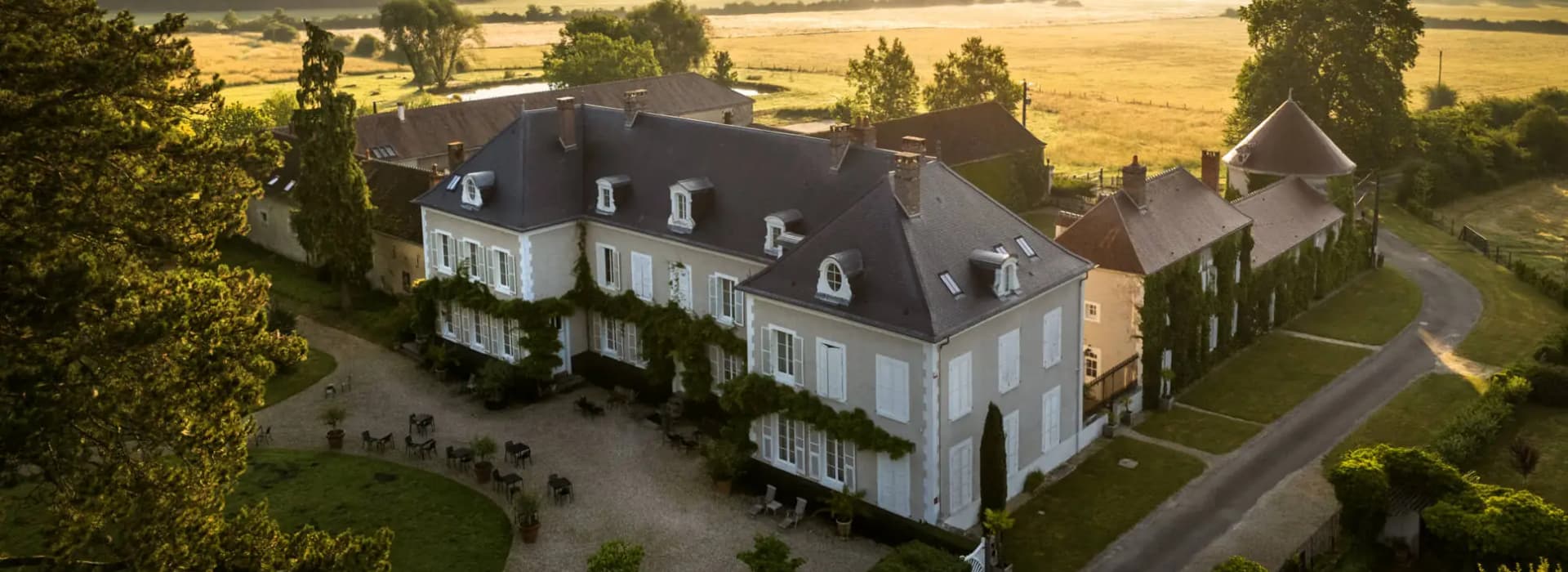
Perched on a hilltop in the commune of Montigny-la-Resle, fifteen minutes from Auxerre and twenty from Chablis, this 17th-century manor sits under two hours from Paris and feels like another century entirely. A boutique hotel with only ten rooms, a private art collection numbering several hundred works, a heated saltwater pool, a kitchen garden feeding a restaurant that changes its menu weekly, and an atmosphere closer to staying in someone's extraordinary home than checking into a hotel.
Why Auxerre Is One of France's Most Underrated Destinations
Most travellers driving south through Burgundy are headed somewhere else. Beaune, Dijon, Lyon. The Yonne gets barely a glance, treated as nothing more than the place where the grapes begin. This is a mistake I am glad I did not make.
There you’ll find the city of Auxerre which sits on a hill above the River Yonne, its roofline a dense crowd of medieval half-timbered buildings, Gothic spires and Romanesque towers. The waterways running through the city shape its atmosphere entirely. Walking the riverside promenades in the early morning you understand immediately that this is a functioning provincial town where local routines remain intact. People are the polar opposite of Parisian here. They walk their dogs along the Yonne riverbanks after picking up their daily baguette, quick to greet a stranger with a bonjour or to stop and make small talk, unhurried and genuinely warm. It feels culturally distant from Paris despite being barely two hours away. Slower, quieter, and far more connected to the agricultural and architectural identity of Burgundy in a way the capital is not.
Joan of Arc passed through in 1429. Napoleon stopped here on his return from Elba. The Cathedral of Saint-Étienne floods its Gothic nave with shifting pools of ruby and cobalt from some of the finest medieval stained glass in France. The Abbey of Saint-Germain shelters 9th-century Carolingian frescoes in its crypt, among the oldest Christian images in the country. Entry is nearly free and the crowds are negligible.
Auxerre is also the gateway to Chablis, twenty minutes east, where Chardonnay grows from Kimmeridgian limestone laced with fossilised oyster shells that give the wine its famous oceanic minerality. To be based here is to sit at the intersection of history and wine.
The Château Setting: Six Hectares of Burgundy Countryside
The drive up through the village of Montigny-la-Resle gives nothing away. A handful of pale stone houses, a church, the unhurried rhythm of rural Burgundy. Then the road climbs and the château appears on the brow of the hill, and everything makes sense at once.
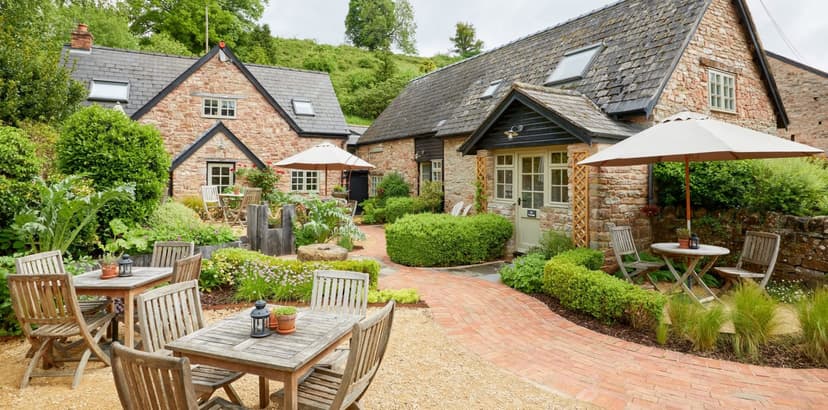
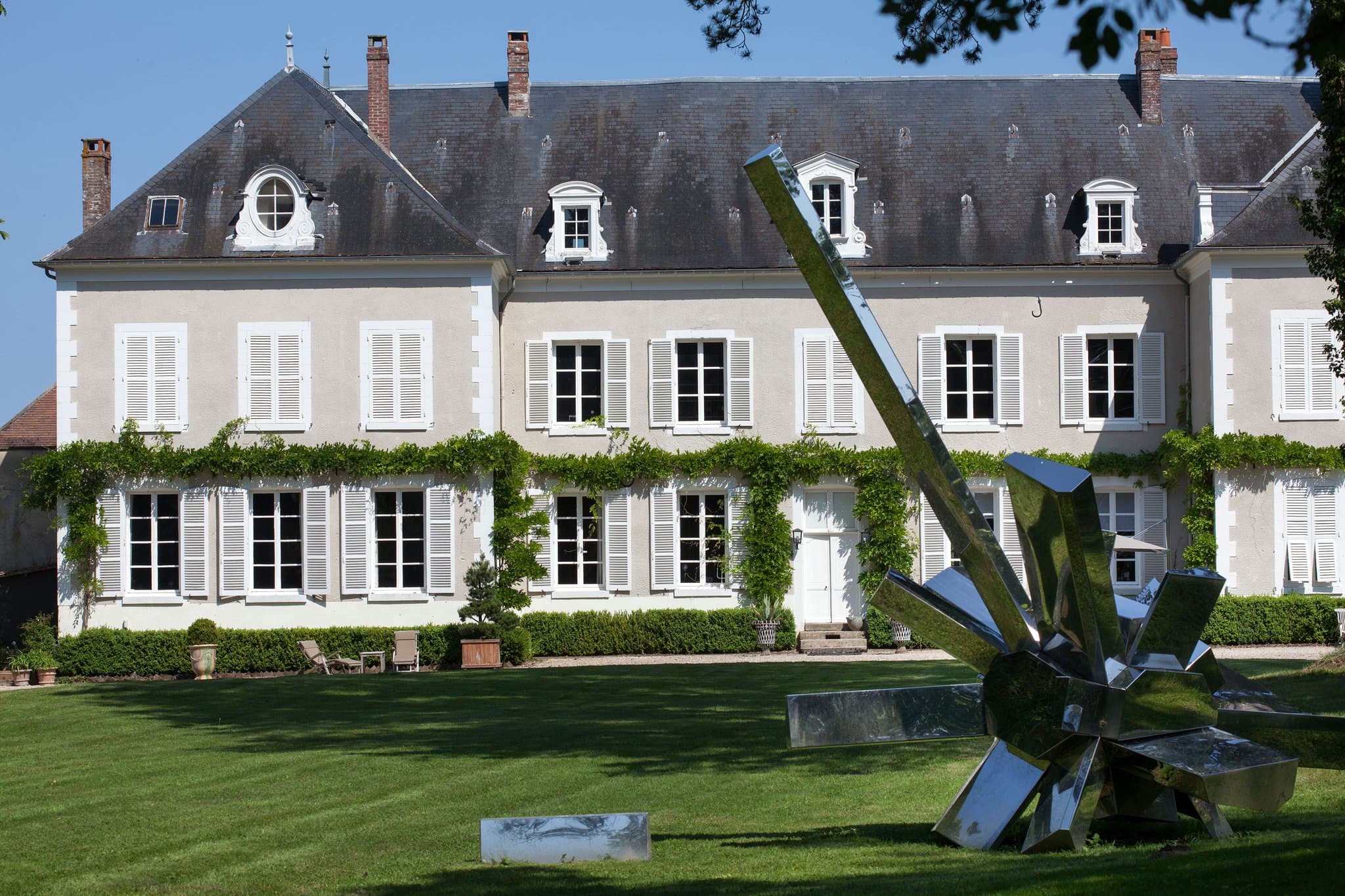
The cream-coloured facade is wrapped in ivy while white louvered shutters frame tall windows. Brick chimneys rise above steep slate rooflines. At one corner, the fort-like round tower with its conical navy-blue roof gives the whole composition its punctuation mark, something irreducibly French.
The grounds are where the château are its soul.. Two hectares of manicured gardens unfold around the building: an orangery, active orchards, lawns that seem improbably green against the Burgundy hillside. In spring, purple wisteria erupts across sections of the facade and along the façade, transforming the property briefly into something close to theatrical before fading gently back with the season. Contemporary sculptures are placed throughout the grounds appearing at the end of paths and beside the tree line. Arik Levy's Rock Growth anchors the park with the authority of something that has always been there: a mirror-polished stainless steel sculpture of faceted arms radiating outward from a central point, each tip catching and reflecting the sky, the trees and anyone passing by. It looks like a mineral that decided to grow.

A pétanque court sits beneath the trees. The heated saltwater pool, framed by timber decking and sun loungers, holds the afternoon light like a mirror. Behind the estate, 800 hectares of forest ensure a silence that is almost physical. In the evenings after dinner, walking those grounds with a glass of local Chablis in hand and the valley below gone dark and quiet, is one of the finest things I did all weekend.
A member of the small team greeted me on arrival, not a bellboy. She handed over the keys, actual keys, and showed me around without ceremony. No check-in desk, no formality. Just the immediate sense of being welcomed into someone else's remarkable home.
A Living Art Collection: Bold Colours and Contemporary Masterworks

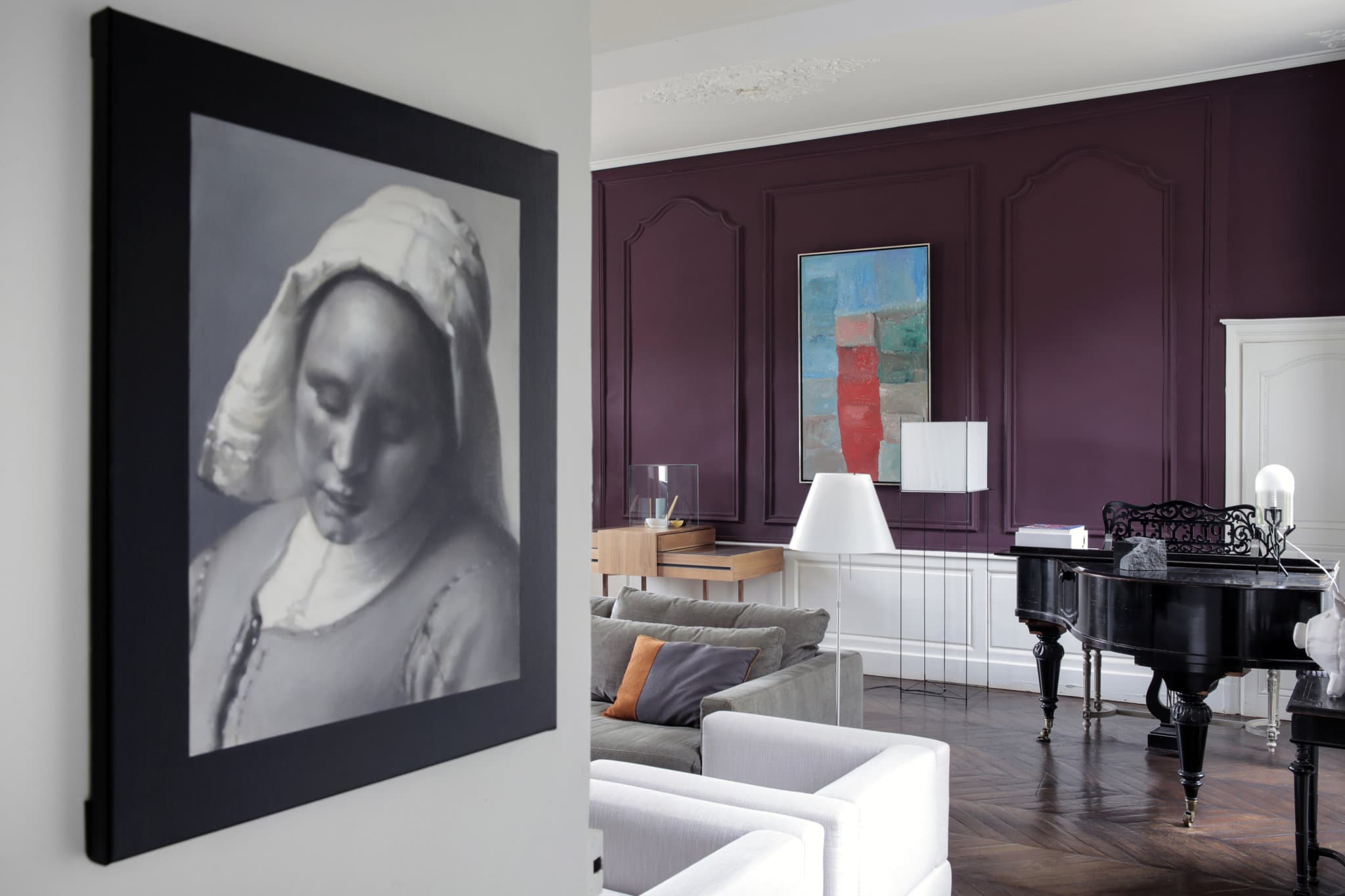
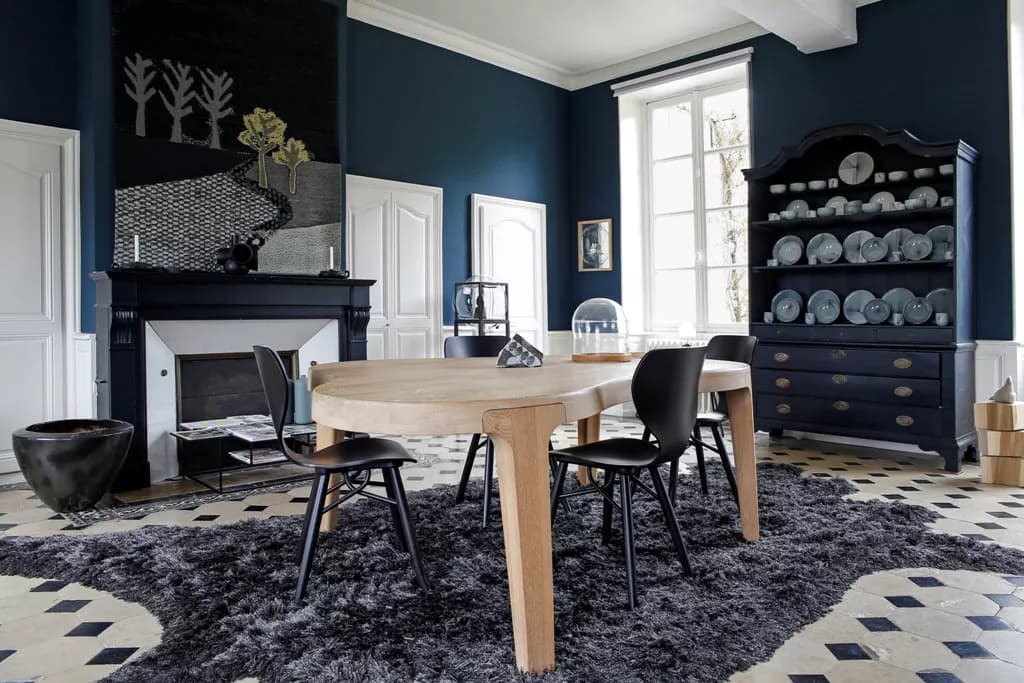
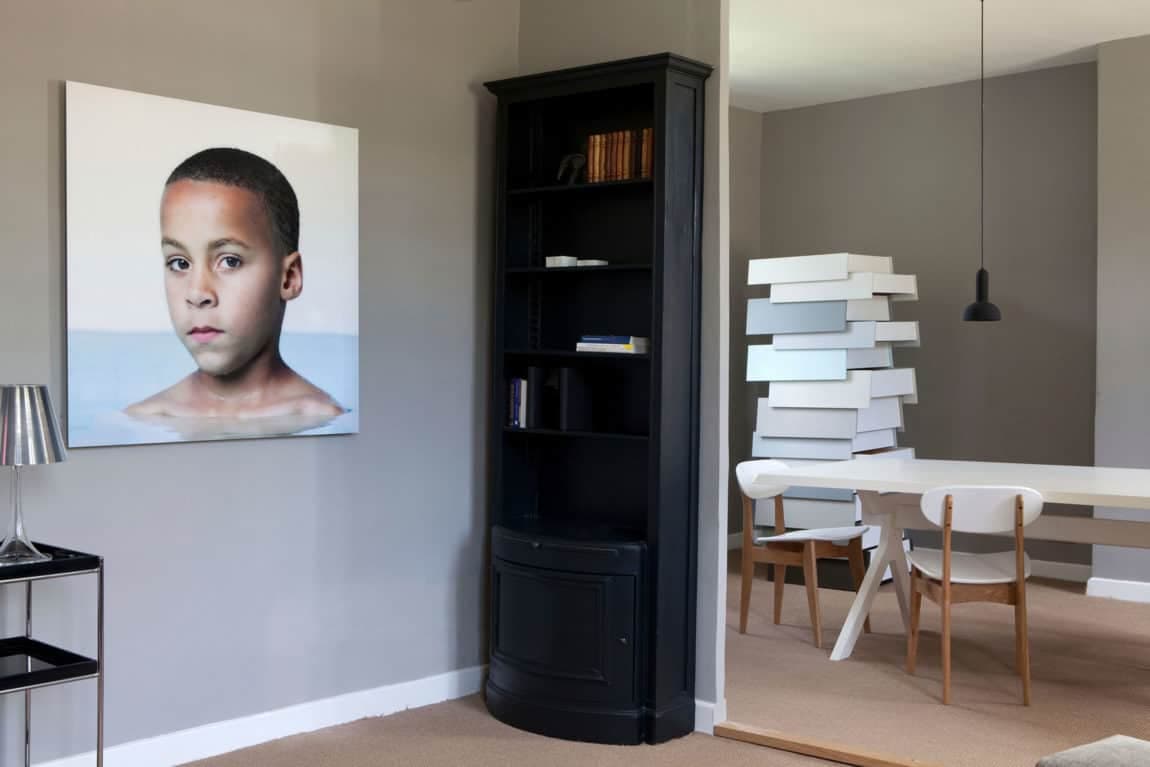
Step through the door and the bold colour hits you immediately. The walls of the main building are dressed in deep, saturated Farrow and Ball tones: rich navies, dark bottle greens, blacks and chalky whites deployed with real confidence against original Burgundy stone floors laid in the classic pattern of pale squares punctuated by dark diamond cabochons. The main lounge in particular uses a dramatic wine or plum toned wall treatment that sits somewhere between oxblood, aubergine, and Burgundy red. It is not bright or decorative in a conventional château sense. Instead, the colour gives the room density and weight, almost gallery like in how it frames the contemporary art and black grand piano. At its centerpiece is the neoclassical fireplace carved in rose toned marble with soft mauve veining, with a restrained upper frieze where shallow geometric carving replaces traditional ornament. The decision to use such strong colour in a house of this scale was entirely deliberate. Where other château restorations default to pale stone and neutral linens, this property uses colour to pull the large rooms inward, making them feel inhabited and warm rather than grand and remote.
And against those walls, the art begins.

I spent the better part of an afternoon moving through the rooms and the experience built steadily, piece by piece. A large canvas in the drawing room stops you. Then a sculptural piece in the corridor that you almost walk past before it catches you. The drawing room itself is anchored by a Pleyel grand piano from the early 20th century beneath original plasterwork moldings, the white marble fireplace commanding one wall, and around it a gathering of contemporary works that make the room feel electric rather than historic.

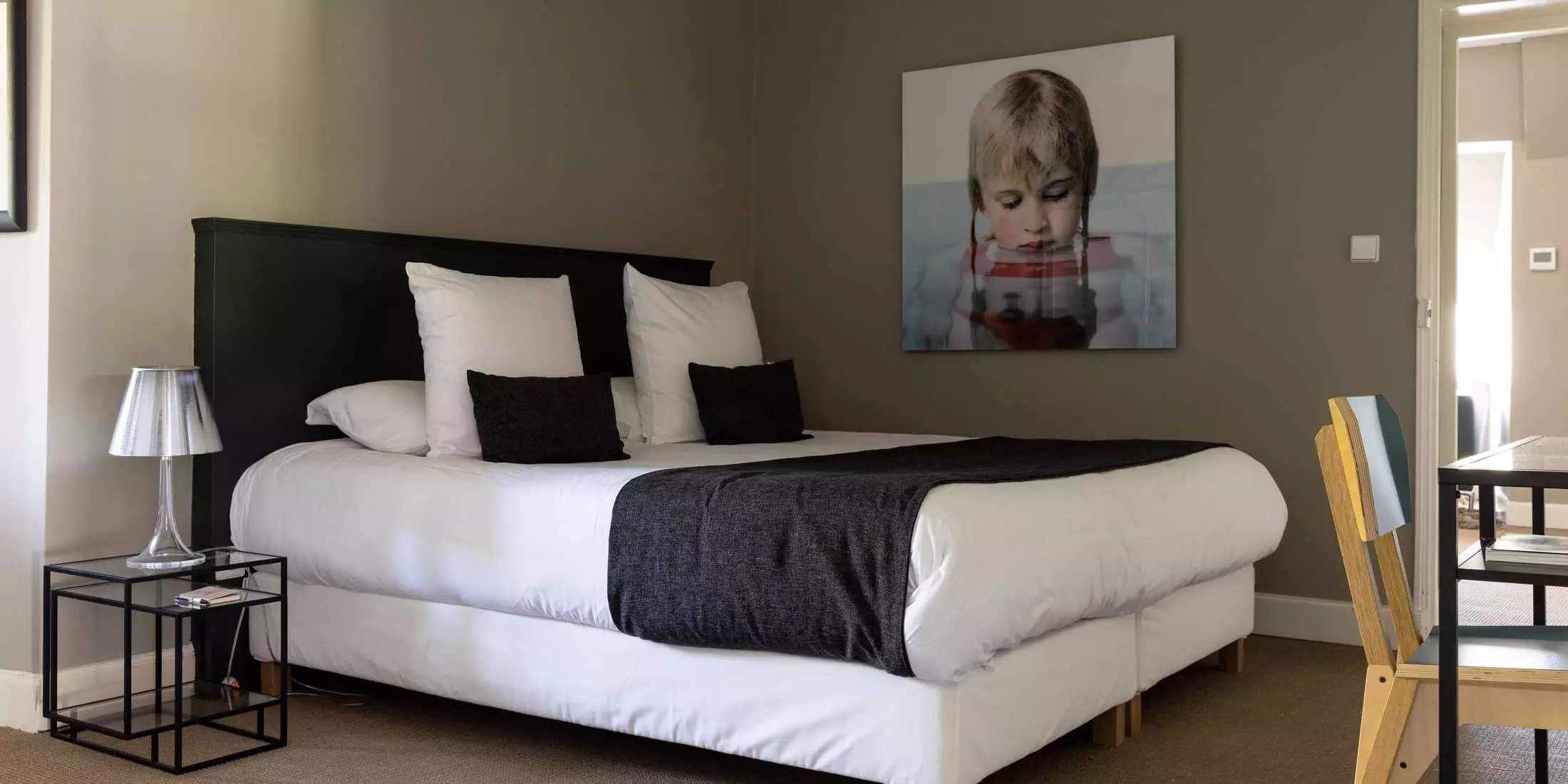
Hendrik Kerstens' photographs hang nearby, his extraordinary portraits reimagining Old Master Dutch painting with contemporary subjects: Vermeer's milkmaid, Rembrandt's collared figures, rendered now with unsettling precision. Hans Hartung's gestural abstracts cover large-format canvases with marks that feel like controlled violence, pulled across the surface with a speed you can almost sense. Ceramic pieces from Cor Unum sit beside design objects by Kiki van Eijk and Lex Pott.
Each room adds another layer. Interesting becomes compelling becomes absorbed.
Then you reach the staircase, and you find the beetles.

Iridescent ceramic beetles line the staircase wall in a dense, climbing formation, each one catching the light differently, each one a small perfect object that is also part of something far larger and stranger. They are the work of Hans van Bentem, the Dutch sculptor whose monumental ceramic and porcelain installations appear in royal palaces and national museums across Europe. His practice draws on Czech glassblowing traditions and Chinese porcelain workshops, combining centuries of craft with a visual imagination that is baroque, playful and serious all at once. Standing in front of the beetles, watching the light move across their iridescent surfaces as you shift your position on the staircase, is the moment the property stops being interesting and becomes genuinely impressive.
The collection runs to several hundred works: paintings, sculptures, photography, ceramics, digital art and limited-edition design pieces. Felt birds in a nest. Ceramic distorted landscapes. Neon lighting to the upper floor. Nature, surrealism and craft in constant dialogue with 17th-century beams and raw stone.

The Rooms and Suites: Ten Individually Designed Spaces
Ten rooms and suites across the main building, the old farmhouse and the converted caretaker's quarters. Each is individually designed and none resembles the one next door.
In the main château, rooms carry the names of local wines. The Irancy rooms, 35 square metres each, are dressed in deep moody blue with dark wood antique furniture, statement chairs and lighting, and contemporary artworks that feel chosen rather than placed. A white marble fireplace anchors one wall. The Chablis room runs to dark green with a red-marble fireplace and morning views over the park toward the Rock Growth sculpture. Every object in every room has been chosen. Nothing was left by accident.

The Montigny Junior Suite occupies the attic where the original roof structure is fully exposed, five-metre ceilings and ancient timber beams overhead, the 18th-century wood and structure combined with three-dimensional marble tiles and powder-white walls, warm in any season.

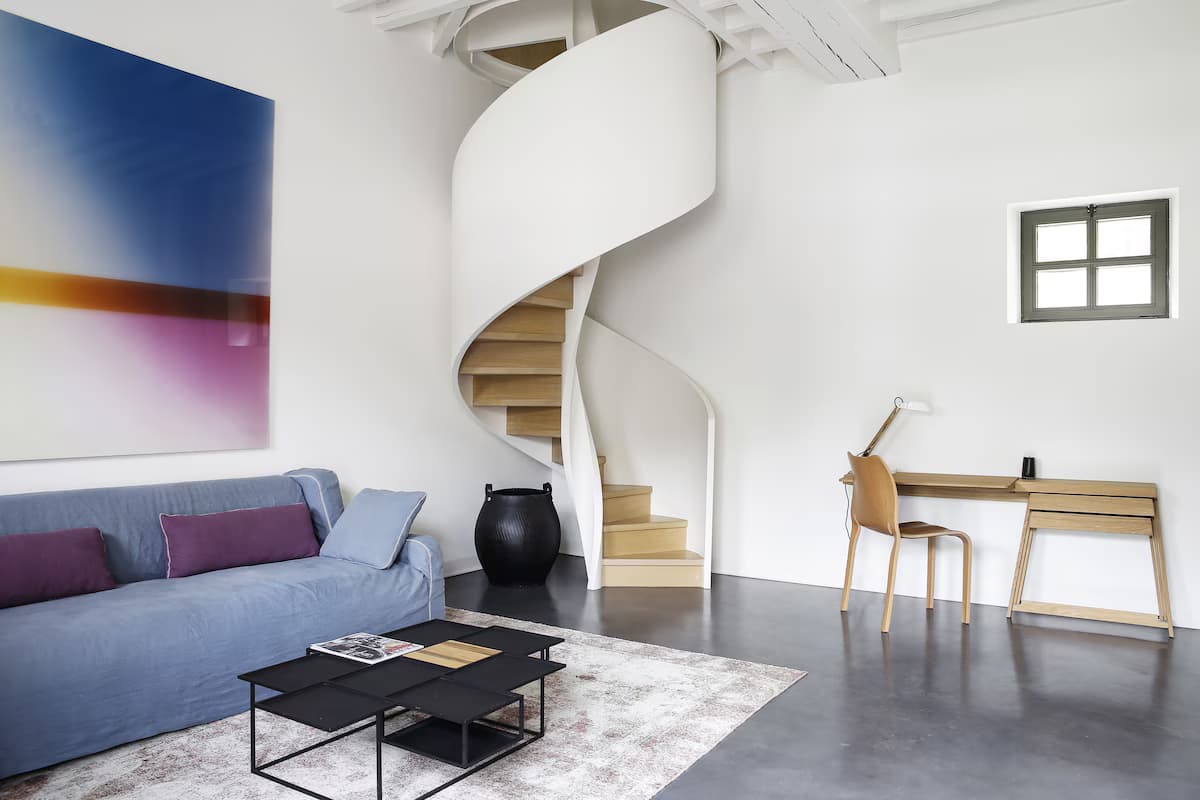
The newer suites in the converted outbuildings are where the design programme reaches its most extraordinary expression. The Vézelay suites cover 50 square metres across two townhouse-style floors: a chic kitchen and living space on the ground floor with glass doors opening directly onto the pool terrace, and the bedroom above under exposed rafters.

The Fontenay suites connect their two floors via a spiral staircase custom-built by a Venetian artisan. The palette throughout these suites reflects a Scandinavian restraint: pale oak, concrete floors with radiant heating, matte black metalwork, natural fabrics. The Fontenay suites carry a freestanding bathtub designed by Patricia Urquiola for the Italian brand Agape, positioned at the centre of the open-plan bathroom like a sculpture. The suite is built around it. You sleep inside art. You also bathe inside it.
Breakfast and Dining at La Table de la Resle
Breakfast runs between 8:30 and 10:30 and is served in a bottle-green scullery dining room that is itself a piece of art direction, deep and saturated in colour, set with custom ceramics holding pastries delivered that morning from the local bakery. In warmer months it moves to the terrace overlooking the grounds, where the morning light comes at the gardens sideways and the valley below is still finding itself.

Fresh pastries, artisanal breads, homemade jams, local cheeses and charcuterie, organic eggs, regional honey. No one hurries you. In a house with only ten rooms, time is genuinely on the menu.

Dinner at La Table de la Resle is served exclusively for hotel guests. The menu changes weekly according to what the estate's kitchen garden and the surrounding region are producing: rooted, vibrant and sincere are the words the kitchen uses for its own philosophy, and they are accurate. Three courses built from responsible farming and a supply chain short enough to taste. The Chablis pours are mineral and austere and very good. After dinner, the honesty bar stays open and the château at night, stone cooling and the valley gone dark below, is one of the finest places I have spent an evening.
Touring the Chablis Wine Region and Burgundy Villages
While you’re there, you are nearby the famous classified crus of Chablis, Montée de Tonnerre, Vaudésir, Les Clos which grow twenty minutes east on limestone slopes that Cistercian monks began cultivating in the 12th century.

Clotilde Davenne, one of the pioneering women winemakers of Chablis, is known for her precise, mineral driven wines that foreground clarity over ornament, shaped by vineyards that sit just above and around the town. One experience with her moves beyond the cellar: a drive in a low slung yellow Méhari through Chablis and up toward the grand cru slopes, tracing the ridge where the most celebrated parcels meet the limestone. The road reveals the geography in layers, with the village falling away below and the famous sites stretching east across pale stone.

At the top, tasting her best vintages while looking out over Les Clos and Vaudésir gives the wines a different register. The acidity feels more linear, the citrus more defined, the chalk core more present, as though the landscape has been distilled directly into the glass.

For something less touristic, Irancy produces a quiet earthy Pinot Noir on iron-rich slopes south of Auxerre that rewards proper attention. Saint-Bris-les-Vineux offers Sauvignon Blanc classified as Burgundy, from cellars carved into the hillside. The Canal du Nivernais runs close by, ideal for a bike ride along the banks. The walled medieval village of Noyers-sur-Serein, fifteen minutes south, is one of the most perfectly preserved in France and almost entirely undiscovered.
Why Château de la Resle Is Worth the Journey
On the last morning I sat on the terrace with coffee looking down the valley. The light was the particular light of Burgundy in the early morning: low, golden, slightly milky, the kind of light that makes ordinary landscapes look like paintings. The pool was still. The wisteria had gone over for the season but the garden held its shape beautifully without it.
Château de la Resle works because it is a place to live even for just a holiday. It is not a museum version of château living, not a recreation of something that once existed. It is an evolving creative estate where art, architecture and hospitality intersect naturally. A new team took ownership in 2025 and is deepening the estate’s connection to its setting through careful, measured changes. Architecturally, a conical tower once used for raising pigeons is being transformed into a wine cellar, its stone walls offering natural stability for ageing bottles. In the adjacent storage space, plans are underway to extend the restaurant, bringing it closer to the heart of the estate’s daily life and strengthening the link between kitchen, garden and house.

Staying here is not renting a room for the night. It is a temporary inhabiting of a carefully composed private world, shaped as much by contemporary creativity as by Burgundy’s history. You move through spaces where landscape, art, and daily life are held in deliberate balance. You arrive as a guest. You leave slightly changed.
The Details: Château de la Resle, Lieu dit La Resle, 89230 Montigny-la-Resle. chateaudelaresle.com. Rooms from approx. Member of Design Hotels. Michelin Key holder. Book direct for best rate and a complimentary bottle of regional wine. Under two hours from Paris by car or TGV to Auxerre Saint-Gervais, 11km from the château. A car is essential for exploring the region.
Glenn Harris
Glenn Harris is an accomplished journalist focusing on luxury travel, fine dining, and exclusive lifestyle events. His wanderlust has taken him to over 128 countries where he constantly strays off the beaten path to uncover exotic locations, travel gems and exciting experiences to capture.